If You Can Hear the Voice Then You Can Learn
Bazoline (Babeen) Estelle Usher; A Mighty Oak
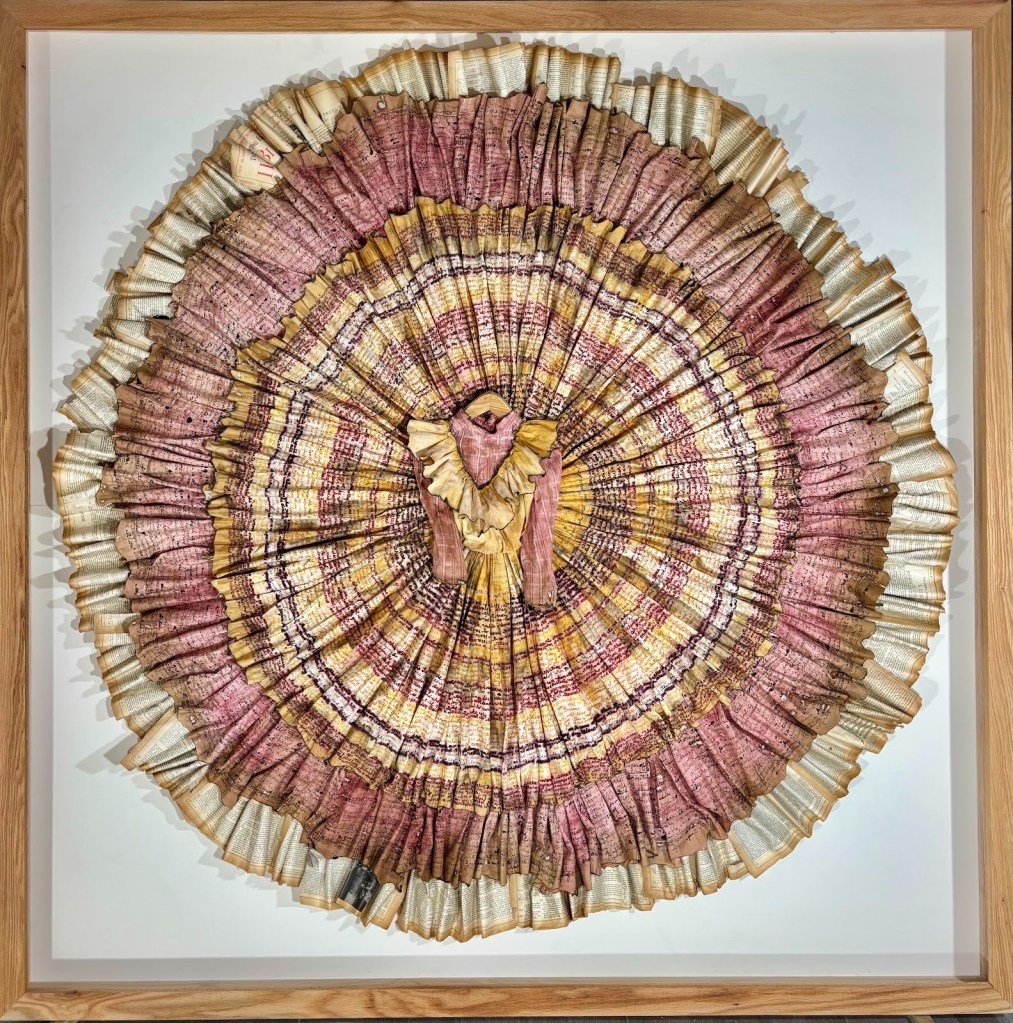
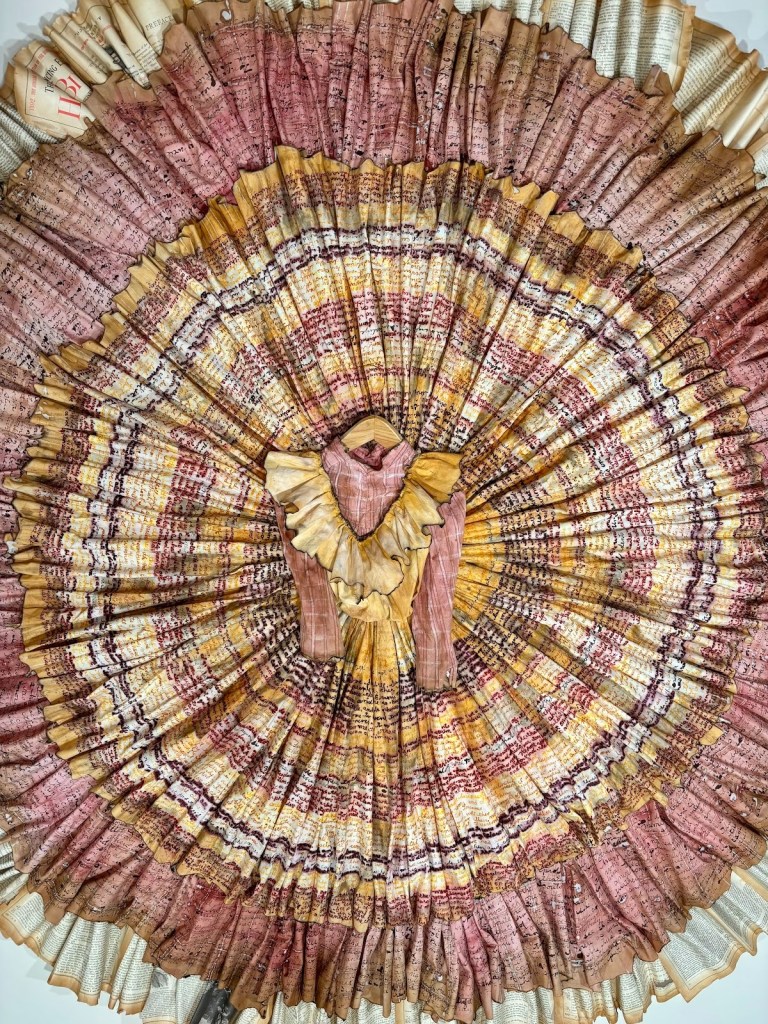
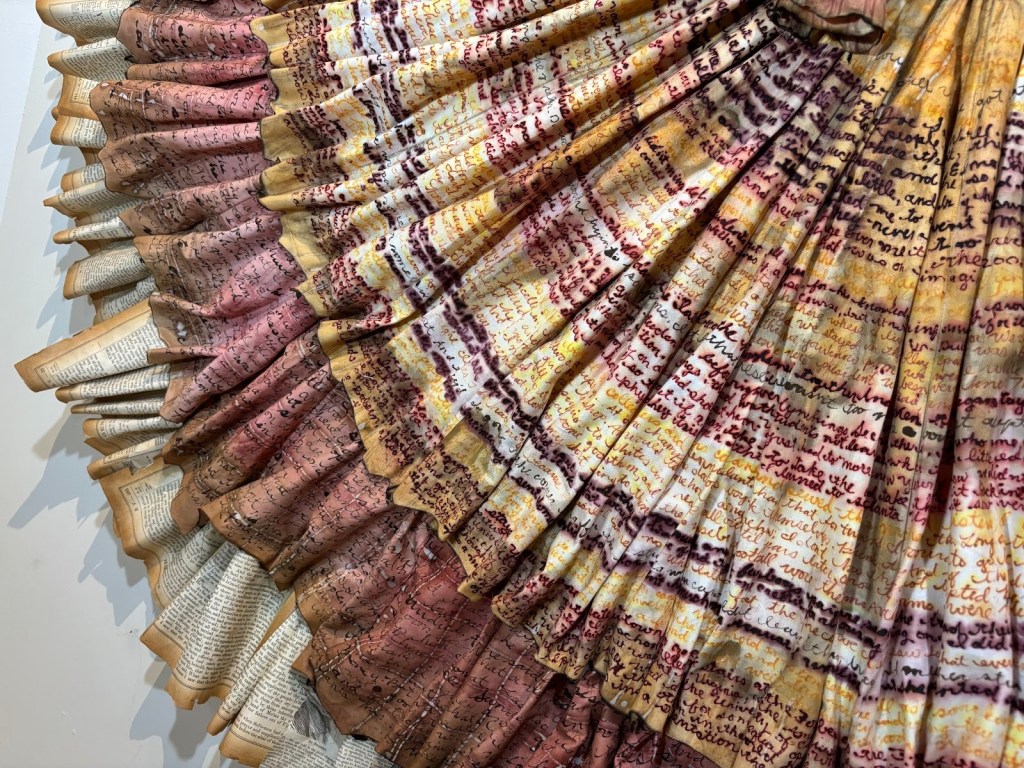
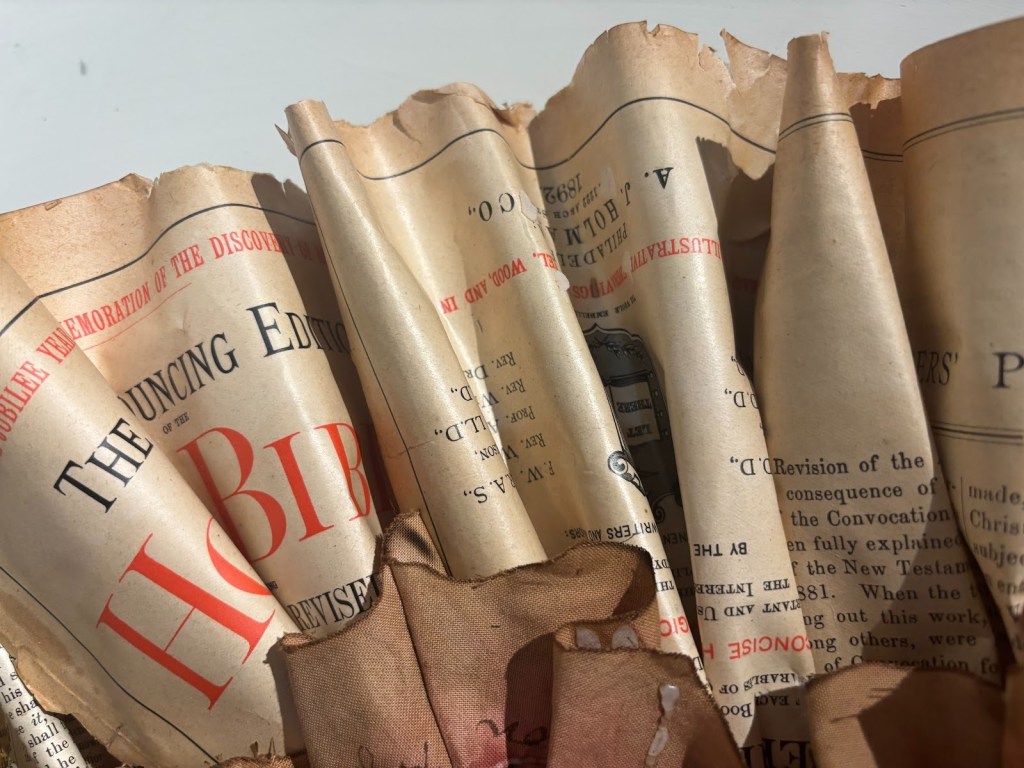
1892 Bible, recycled blouse, cotton cloth, henna, chalk, marker, ink, wax, rust, soil from Walnut Grove, Georgia, burnt edges, button, cosmo flowers, wire, plexiglass, red oak, writings and interviews from Bazoline Usher: Black Women Oral History Project. Interviews, 1976-1981. Bazoline Usher. OH-31. Schlesinger Library, Radcliffe Institute, Harvard University, Cambridge, Mass. Bazoline E. Usher Papers MSS 1239, Kenan Research Center at Atlanta History Center. Special thanks to Clinton Browning, Bazoline’s great-grandson 74 x 74 x 4.3 in. 2025.
Education was at the center of Bazoline “Babeen” Estelle Usher’s life. She was born in Walnut Grove, GA and started school at the age of four. Clinton Browning, her great-grandson, shared a story illustrating her persistence : One morning, as Bazoline was on the way to school, she saw a man hanging from a tree. The adults quietly took him down and prepared him for burial. Despite these hardships, she pressed forward and still went to school. Bazoline was taught that if you didn’t show up, you would lose your seat and couldn’t return and learn. This determination remained a theme throughout her life.
Pushed by a desire to educate their children, her parents eventually made their way to Atlanta, where Bazoline enrolled in high school at Atlanta University under the tutelage of W.E.B. DuBois. She lived through the 1906 Atlanta Race Massacre and witnessed extreme discrimination because of Jim Crow laws. Later in life, she said that there wasn’t anything that she could do about the discrimination and unequal treatment in Atlanta. Though she felt unable to transform policy, she remained unsinged by the fires of bigotry around her and took advantage of every opportunity to increase her education. When such opportunities were not readily available, she said, “If you can hear (the teacher’s) voice, you can learn”. Bazoline always kept her ears open to education. In every setting, she excelled. She was salutatorian of her class, the first principal of an all-black faculty and student middle school, and the first African American to have an office at City Hall in Atlanta, where she served as Director and Supervisor of Negro Schools. She started the first black Girl Scout troop in Atlanta, she was an athlete, and a founding member of the Uplifters Club at the Friendship Baptist Church, the oldest Baptist church in Atlanta, where she also served as the Sunday School Supervisor. She was associated with W.E.B. DuBois, the Alonzo Herndon Family, Mernard Jackson, and many other influential people of Atlanta. She witnesses 106 years of Atlanta’s history.
Bazoline was small in stature. She never married, but cared for many, including her mother and her adopted niece. Throughout her life, she witnessed and was part of the changes that took place in Atlanta’s school system, growing to provide education for all. Her steady patterns of learning and filling her life with service radiated, like a mighty oak, creating a lasting impact on society.
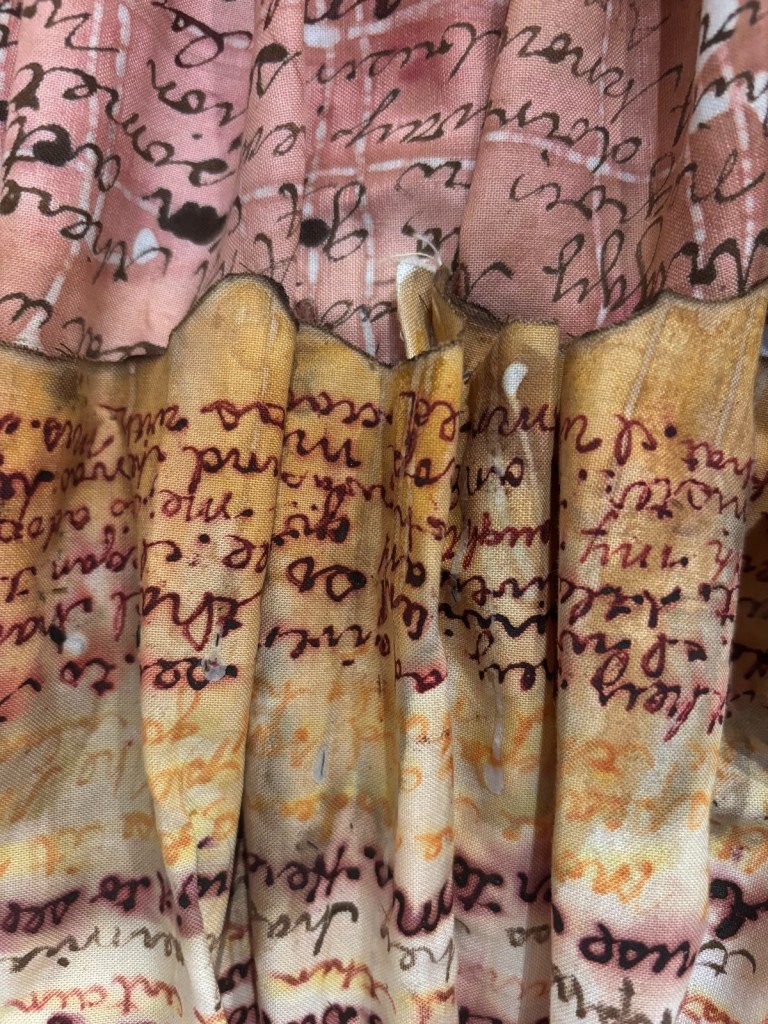
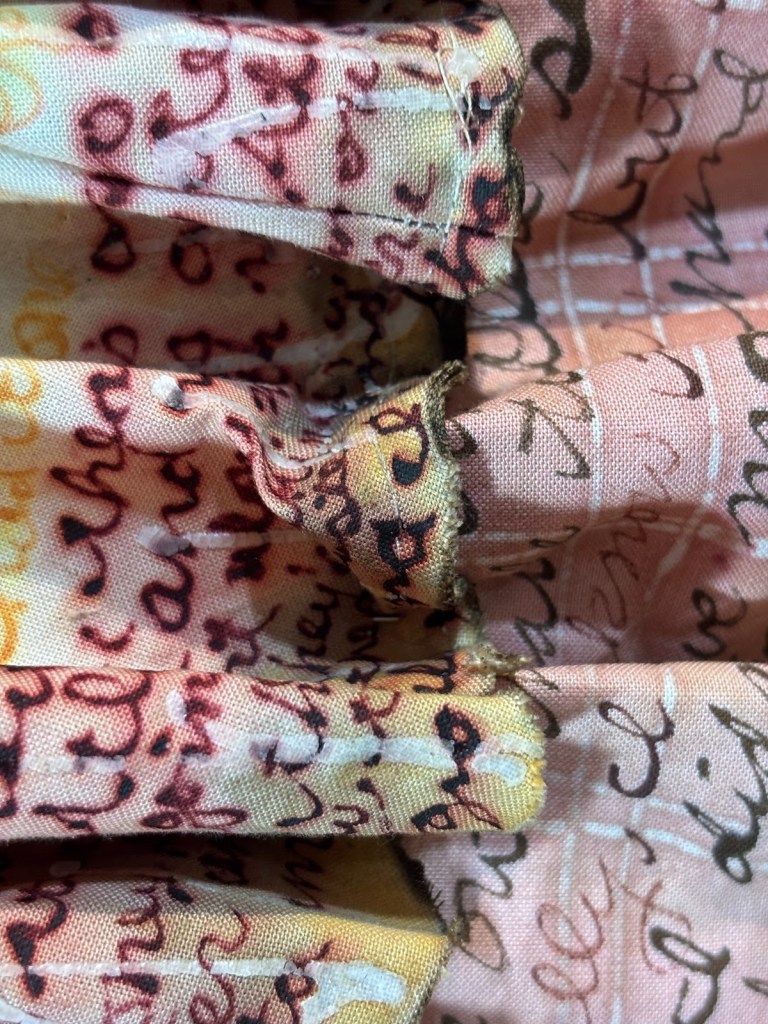
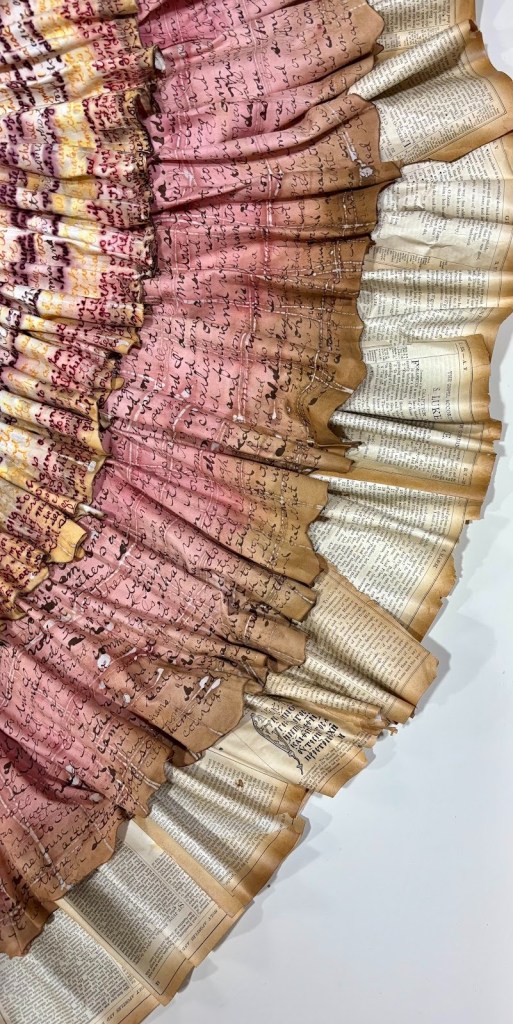
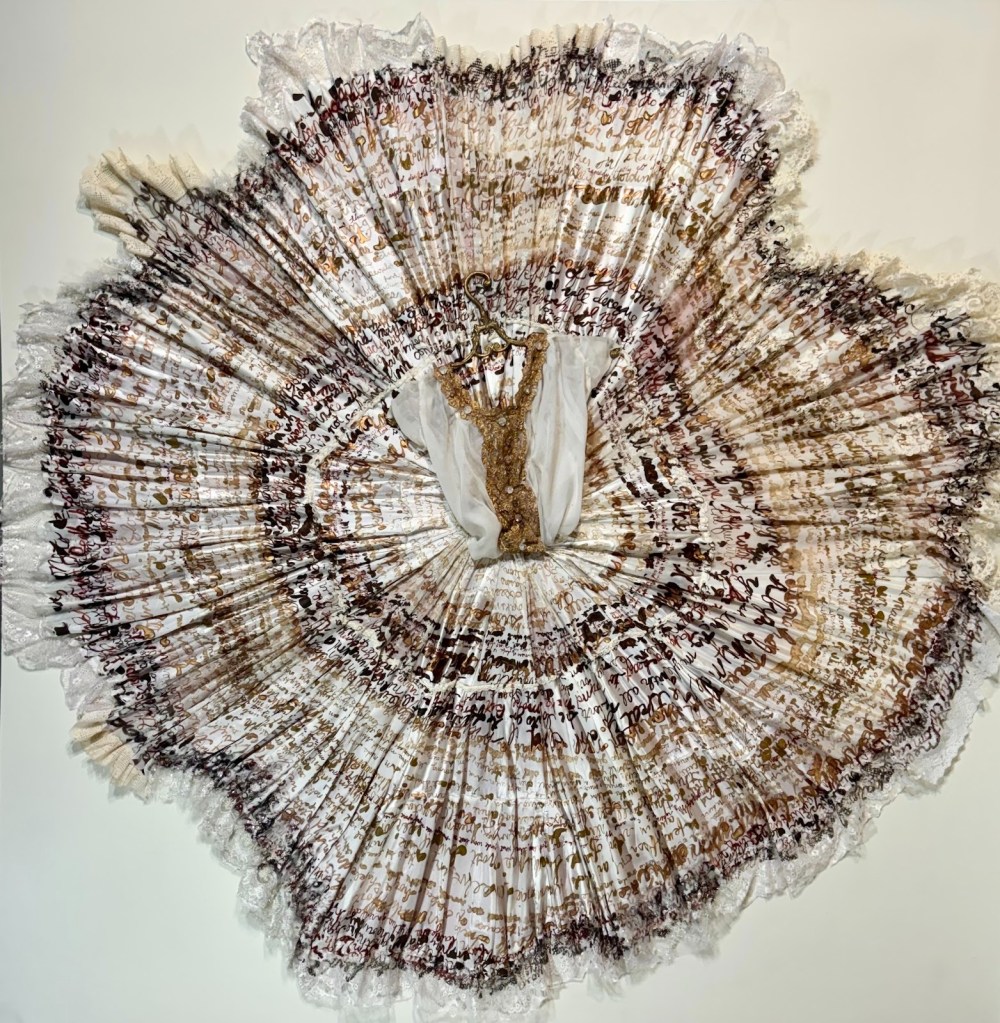
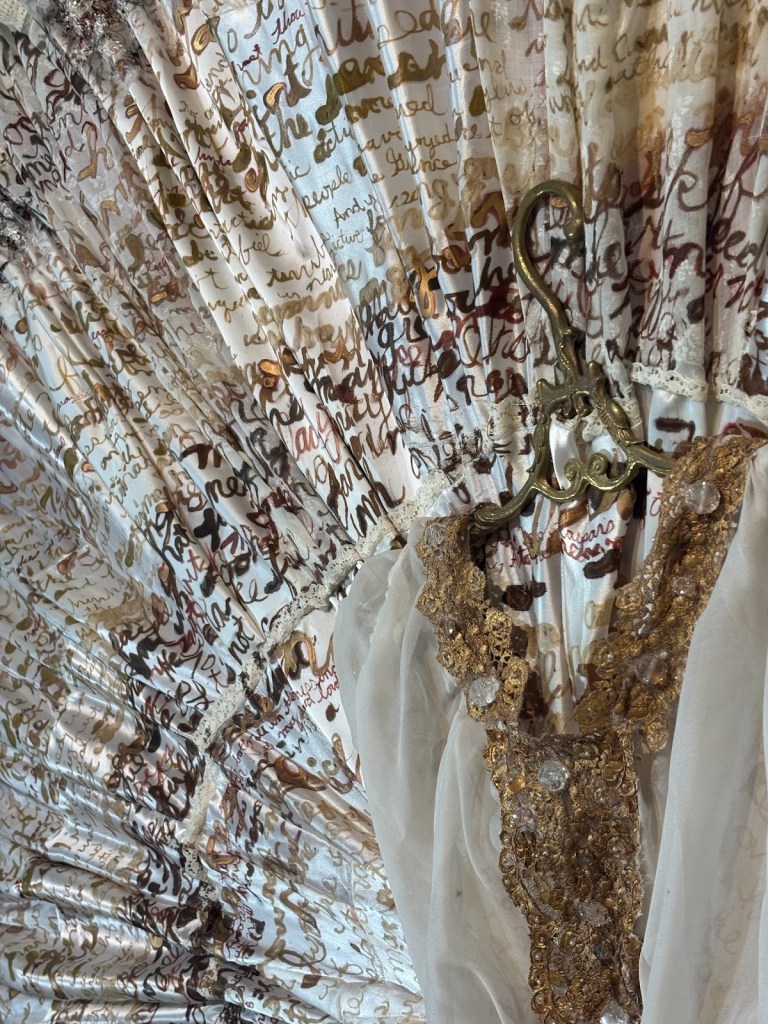
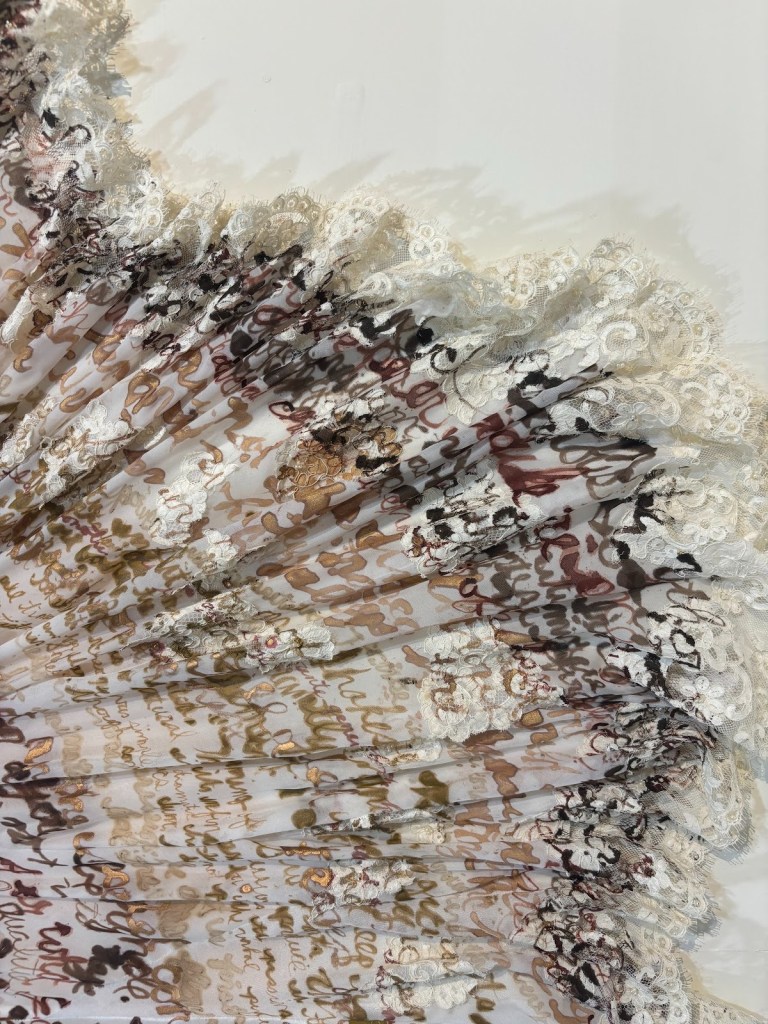
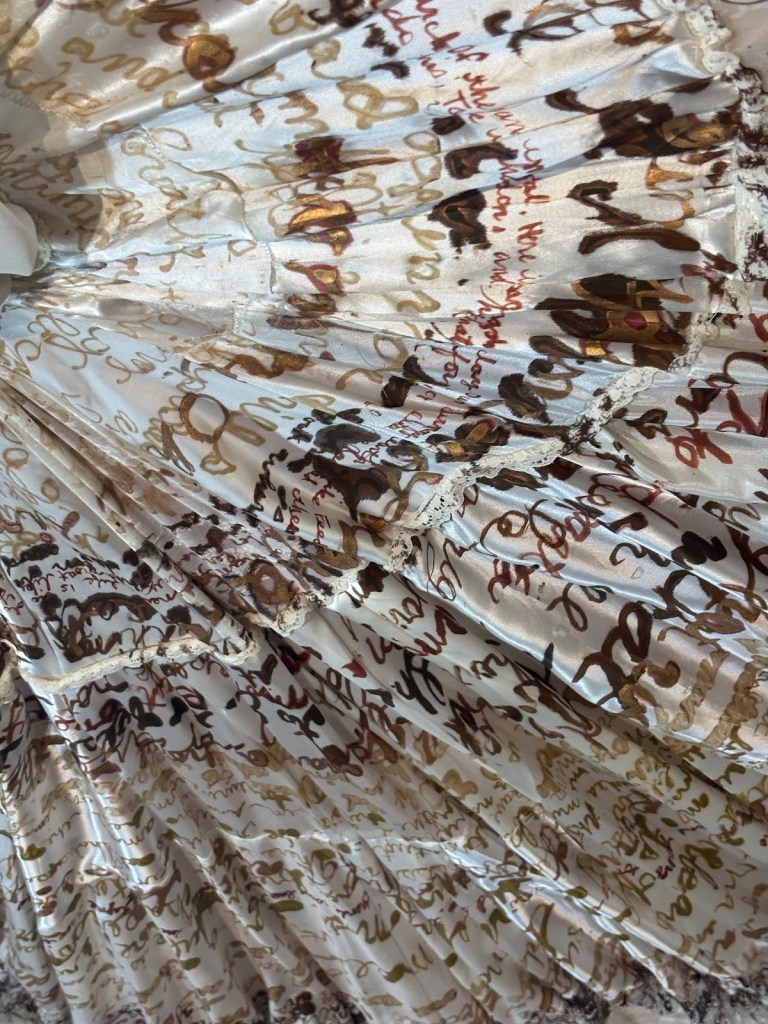
Bazoline’s dress is made from cotton fabric, an old bible, and a blouse. The edges of the fabric are singed with fire, suggesting a phoenix rising from adversity. The patterns and lines of the fabric are drawn with melted wax and chalk. A tiny bodice lies at the center of the dress, radiating the text of her words outward. The text consists of interviews and journals: words from Bazoline. Her words are marked, inked, and stained into the dress. Bazoline’s dress is supported and uplifted by the Bible, whose pages create the outermost layer of the dress. The entire work rests inside an oak frame, representing the structure and foundation Bazoline provided for those around her.
Bazoline’s dress is made from cotton fabric, an old bible, and a blouse. The edges of the fabric are singed with fire, suggesting a pheonix rising from adversity. The patterns and lines of the fabric are drawn with melted wax and chalk. A tiny bodice lies at the center of the dress, radiating the text of her words outward. The text consists of interviews and journals: words from Bazoline. Her words are marked, inked, and stained into the dress. Bazoline’s dress is supported and uplifted by the Bible, whose pages create the outermost layer of the dress. The entire work rests inside an oak frame, representing the structure and foundation Bazoline provided for those around her.
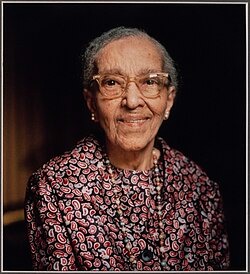
Portrait by Judith Sedwick, 1982
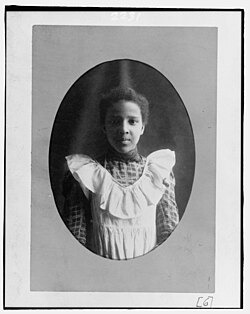
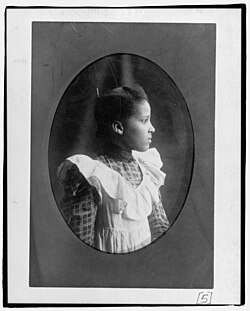
Photos taken by Thomas E. Askew for WEB DuBois c.1900
Adrienne Herndon; Mahogany
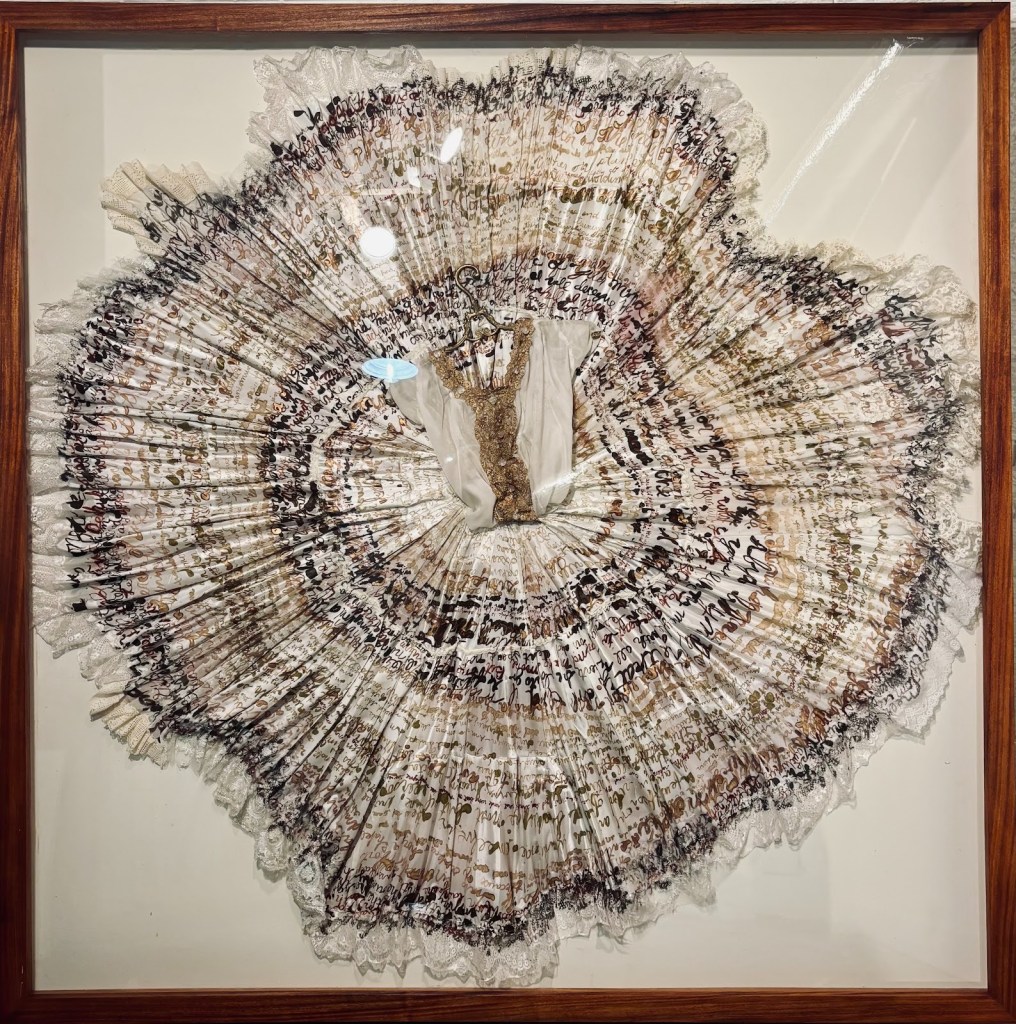
Clothing remnants from dresses, a robe, lace, and beads. Gold leaf, ink, henna, acrylic paint, antique hanger, plexiglas, mahogany. Herndon, Adrienne McNeil. “Our Work in Elocution.” The Bulletin of Atlanta University, May 2, 1897. Herndon, Adrienne McNeil to Booker T. Washington. (February 12, 1907): 216-17. In Louis R. Harlan and Raymond W. Smock, eds. The Booker T. Washington Papers, Urbana:; University of Illinois Press, 1980.“Life Works Opens for Southern Woman.” Boston Traveler, January 25, 1904. Edited with an introduction by A.C Cawley. Everyman and Medieval Miracle Plays. New York: Dutton, 1959Shakespeare, William. Antony and Cleopatra. Edited by A.R. Braunmuller. New York: Penguin Books, 1999. Special Thanks to Mary Ionah of the Herndon Foundation.
Adrienne McNeill Herndon was an actress, professor, architect, and the wife of Alonzo Herndon, Atlanta’s first black millionaire. At an early age, she showed a considerable amount of promise as an actor. Born with fair skin, she hid her mixed heritage on the stage. Her desire was to star in all of Shakespear’s plays. She commenced this undertaking, but soon ran into prejudice, and her career was cut short. She returned to her home in Atlanta and received an academic position at Atlanta University, as a professor of Drama and Elocution. She brought Shakespeare and a rigorous standard of elocution to Atlanta University, performing Shakespearean plays each year, at commencement.
She designed her home, which still stands today as a museum in Atlanta: the Herndon house. It is unique in many ways, with a terraced roof which was meant to be used as a stage for performances. Her home is rich with symbolism and reminders of her heritage, as she and her husband forged a future together. In the Herndon home, mahogany wood adorns the walls, with beautiful carvings that have been worked by skilled black artisans. It is a home that is engulfed by culture and the highest society of its day. In Adrienne’s music room, soft pink walls are framed with white and gold embellishments.
The home, in all its luxury, retains reminders of the past. For example, every room has a fireplace, some with cooking pots hanging in them. These do not provide heat for the home or for food preparation. They are reminders of humble beginnings and of slavery. A mural stretches the border of the ceiling in one room, illustrating a symbolic journey of Alonzo’s life: born into slavery, and his rising into an abundant, successful life. Adrienne’s design of this home is almost a set designed for living theater. Her thoughts of how one moves through the home, the symbols, the beauty, and the ability to contemplate and express the past are all read, as one moves through her home.Adrienne’s dress is made from the fabric of multiple dresses, which were found at vintage stores, and include a wedding dress, woman’s vintage night gown, laces, and beads. The text on the dress includes Adrienne’s own words from articles she wrote or quotes from newspapers and her letters. Much of her writings talk about her work in elocution, the study of expressive speech, pronunciation, and articulation. Texts from plays in which she starred, such as Shakespeare’s Antony and Cleopatra, and a play named ‘Everyman’, are also included in the dress. The words flow on the dress like calligraphy, reflecting the concerns of style, beauty, and expression, which were so important to her career. The hanger is vintage, made of brass. It was found on a luxury cruise ship from the 1900s. Her dress is not dyed. It is left white so that words can be the dominant feature, as they were so important in her life.
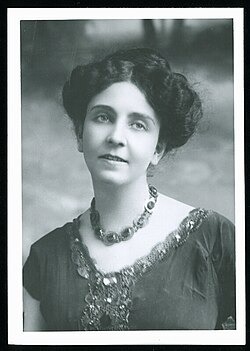
Herndon in 1891
Helen Douglas Mankin; Loblolly Pine
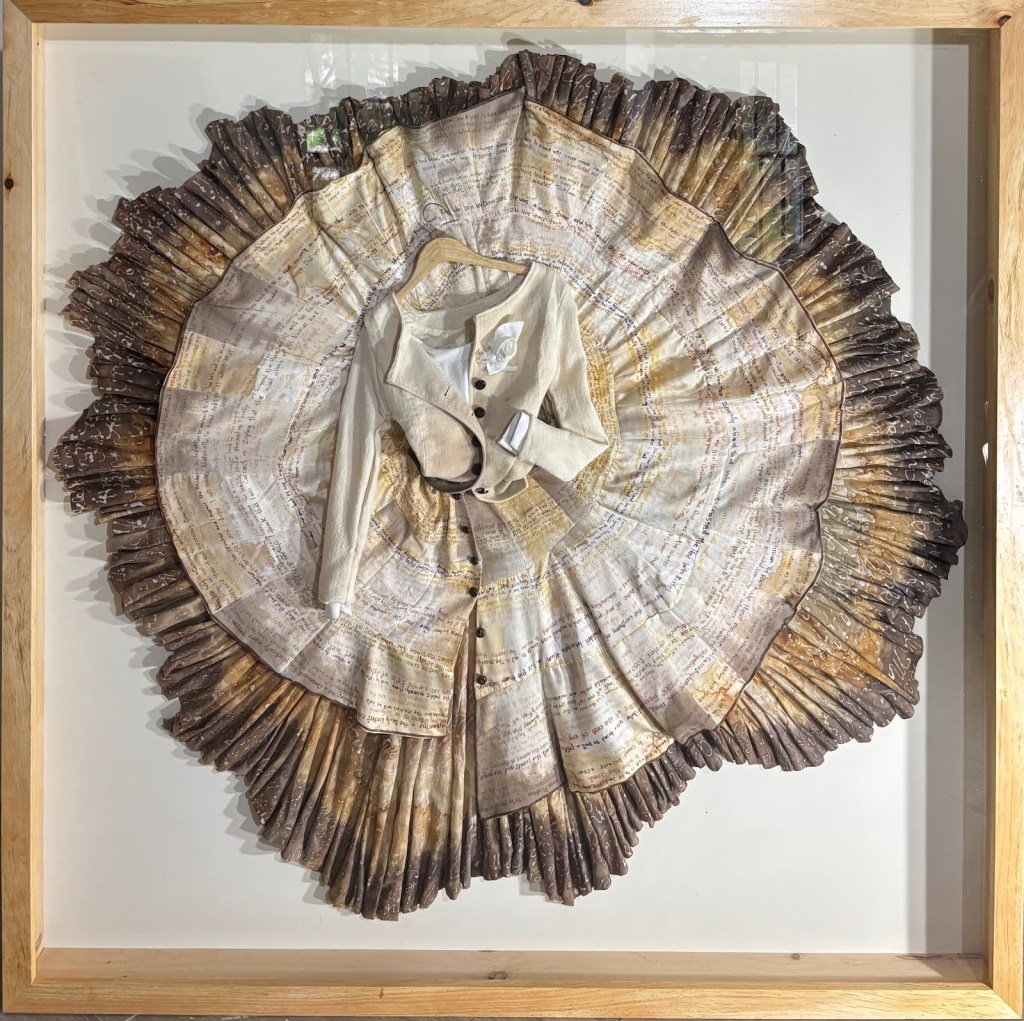
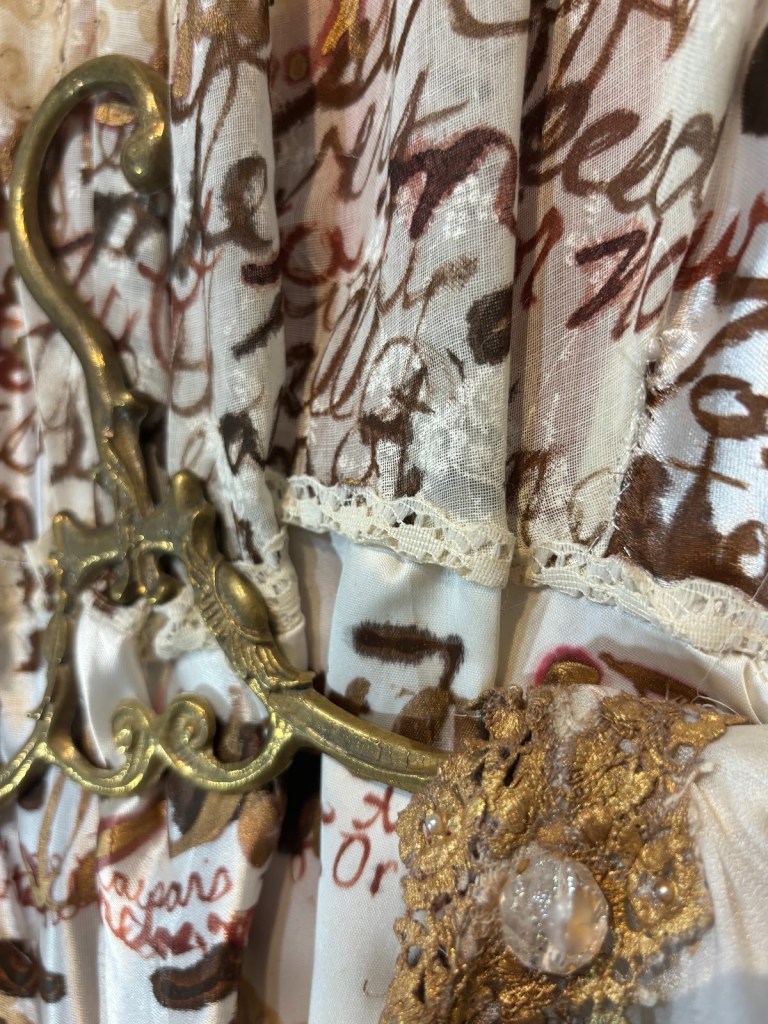
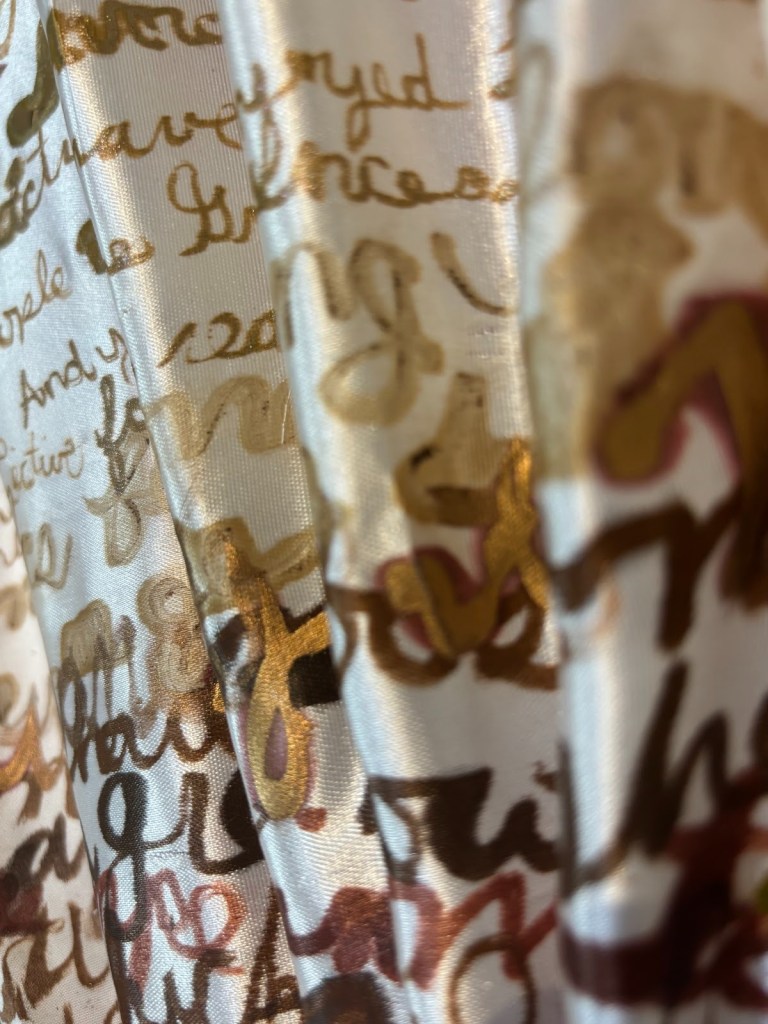
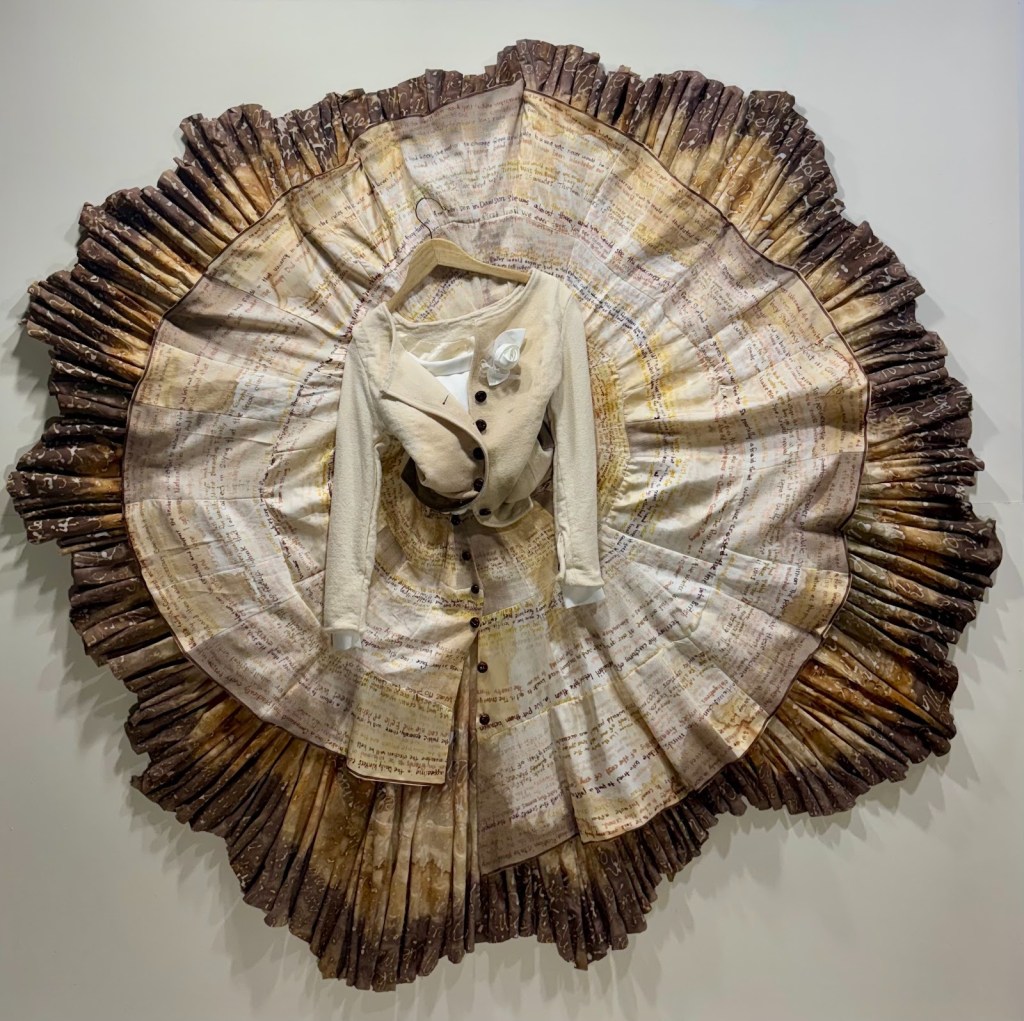
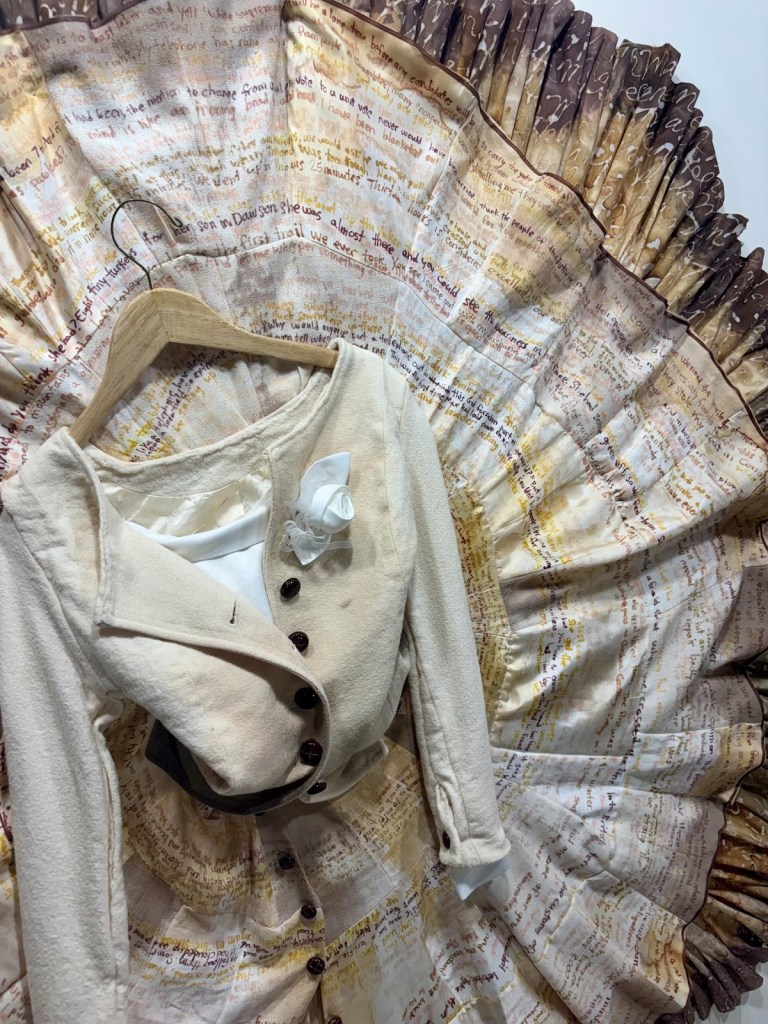
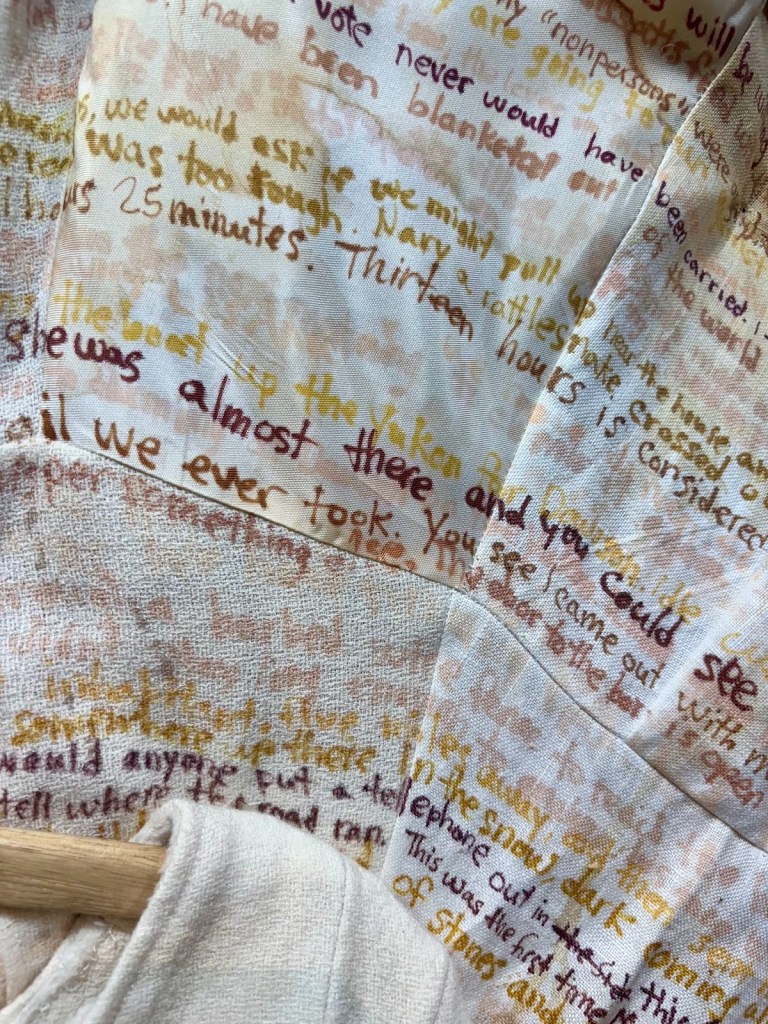
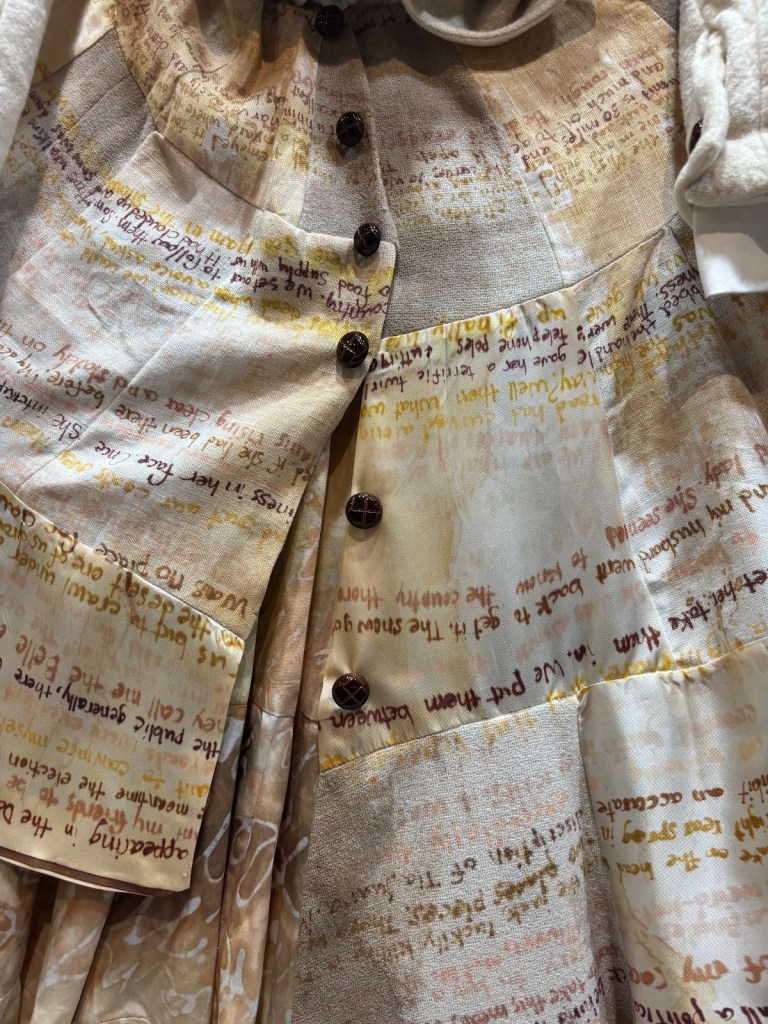
Pine, cotton fabric, remnants of clothing from: women’s wool suit, wedding dress, linen tablecloth, buttons and ribbons, hanger, wax, thread, ink. Iron, onion, marigold, pine bark, and synthetic dyes, plexiglass. Helen’s own accounts of her westward journey by automobile in her beloved “Maxwell” as appearing in the Atlanta Georgian between May and November 1922. Various excerpts from interviews from Helen researched and found in the book: The Belle of Ashby Street, Helen Douglas Mankin and Georgia Politics, by Lorraine Nelson Spritzer.
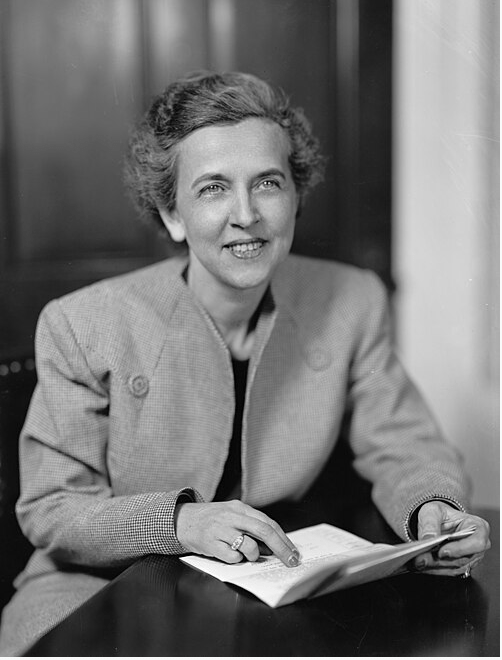
Helen Douglas Mankin was a politician, lawyer, wartime ambulance driver, thrill seeker, and explorer. She was the second woman from Georgia elected to the United States Congress. She was among Georgia’s first women attorneys-at-law. She and her sister, Jean, trekked across the North American Continent in her beloved Maxwell automobile, setting the 1922 touring record for women drivers. She was the second wife to Guy Mankin, and the step mother to his son by the same name; two men rallied around her as she ran for public office. Helen never felt like the weaker sex and was never threatened by traditional gender roles. She believed in pushing boundaries in politics, her employment, and her adventures. She was fearless in doing all things. She was a force to be reckoned with. She was an advocate for the working class and black community. At the outset of her political career,
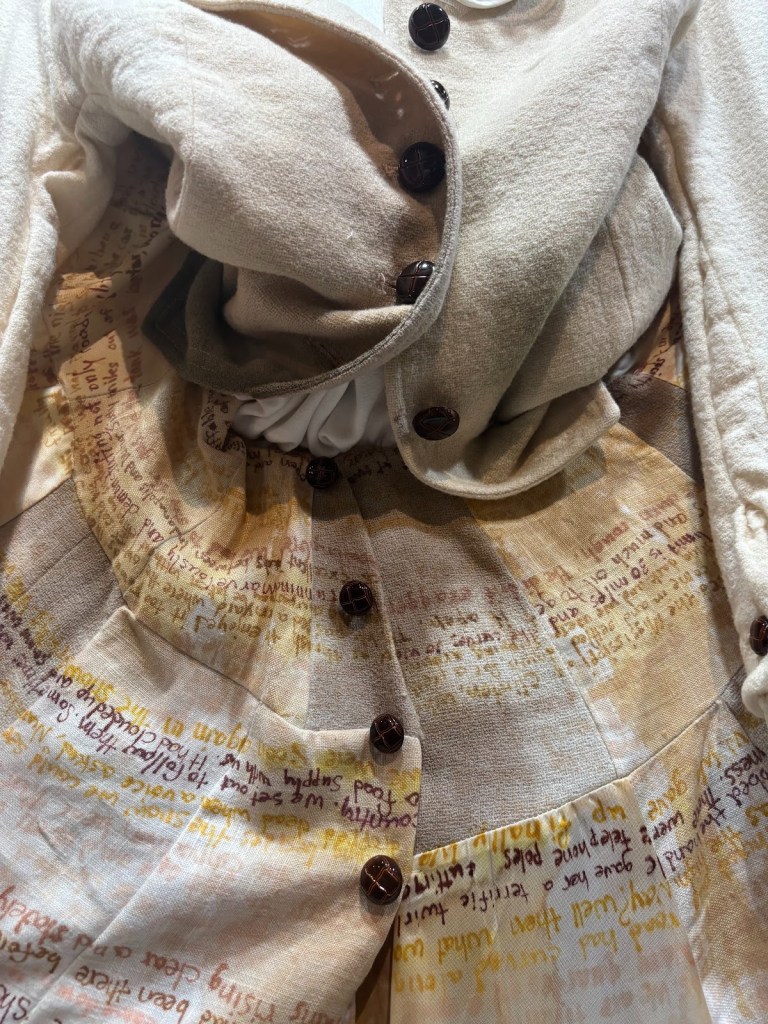
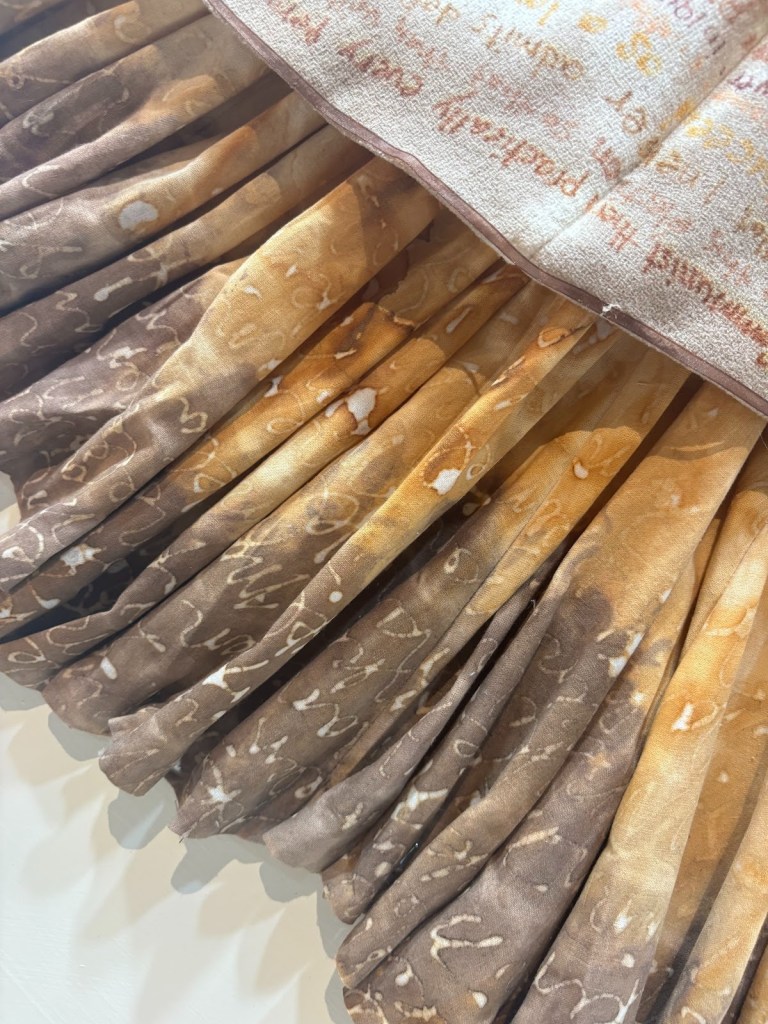
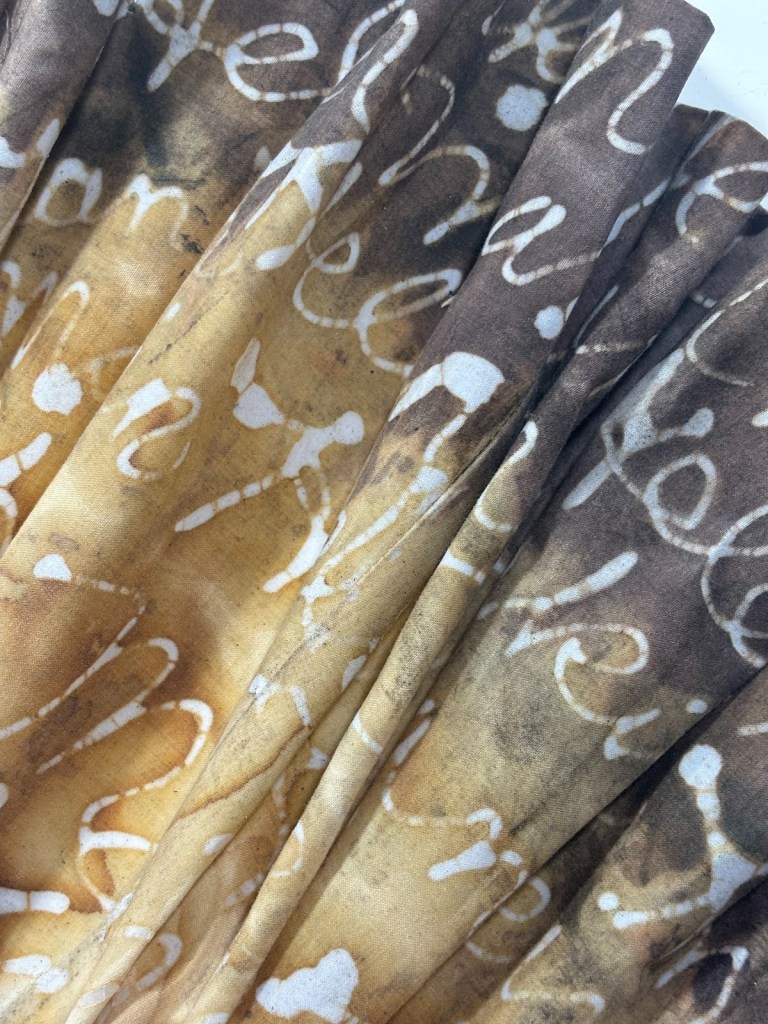
Helen Mankin bought one suit for each campaign and wore it every day, for luck. This work represents one of those dresses: full of wear from a life of service and adventure. The suitcoat in this artwork is worn, tarnished with iron, pine, onion, and flower dyes. A corsage is pinned to the lapel. The dress is made from clothing remnants from local thrift stores: a woman’s wool suit, a wedding dress, a linen table cloth, cotton fabric, buttons, ribbon, hanger. Encircling the rings of the outer skirt are excerpts from Helen’s life. The lines come from her road trip with her sister across the North American continent in 1922, as recorded in various newspapers throughout the United States. After seeing much of the world (including her service in World War 1) she felt beckoned home to Atlanta, to be surrounded by her beloved loblolly pines. The rings of text in the dress continue with words from her time as a US Congresswoman and her battle for reelection in 1948.The bottom layer of Helen’s skirt is made from simple cotton cloth. This skirt is full and tightly ruffled. Helen was elected to congress through overwhelming support from the black community. Although she won a large majority of the vote, she was taken from office through a racist-era voting system rule. This essentially silenced all of the votes cast for her. In this simple underskirt, wax words resist the rust dye, which reveals Helen Mankin’s name over and over again –written in, and counted out– echoing the black vote, the silenced majority. This underskirt upholds the dress, as the voters uphold their representatives, but it also hides the votes cast and thrown away by a racist system. Her skirt opens, as the dress tries to reveal their muted voices.
Mankin
 Sara Lynne Lindsay