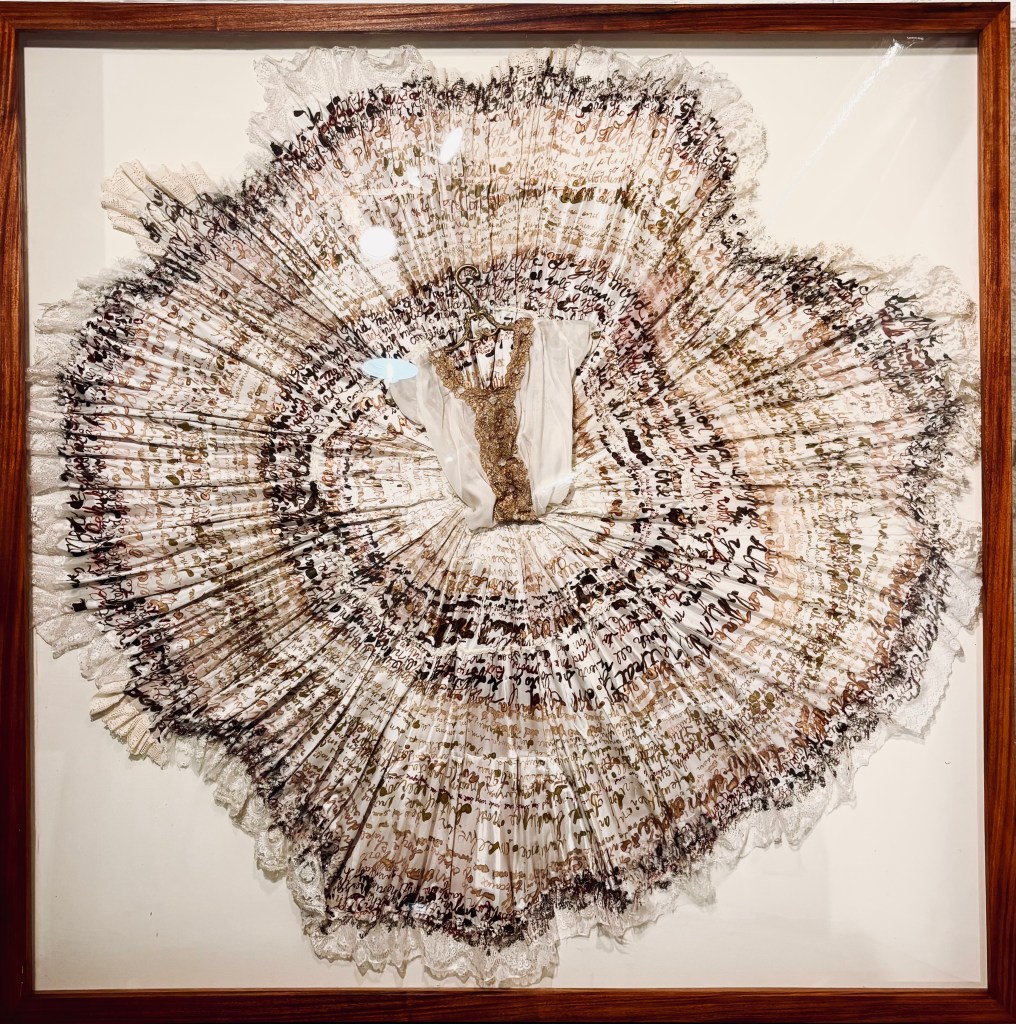
Adrienne Herndon: Our Work in Elocution
Clothing remnants from dresses, a robe, lace, and beads. Gold leaf, ink, henna, acrylic paint, antique hanger, plexiglas, mahogany. Sources: Herndon, Adrienne McNeil. “Our Work in Elocution.” The Bulletin of Atlanta University, May 2, 1897. Herndon, Adrienne McNeil to Booker T. Washington. (February 12, 1907): 216-17. In Louis R. Harlan and Raymond W. Smock, eds.The Booker T. Washington Papers, Urbana:; University of Illinois Press, 1980. “Life Works Opens for Southern Woman.” Boston Traveler, January 25, 1904. Edited with an introduction by A.C Cawley. Everyman and Medieval Miracle Plays. New York: Dutton, 1959 Shakespeare, William. Antony and Cleopatra. Edited by A.R. Braunmuller. New York: Penguin Books, 1999 . Special Thanks to Mary Ionah of the Herndon Foundation. 74 x 74 x 3 in. 2025.
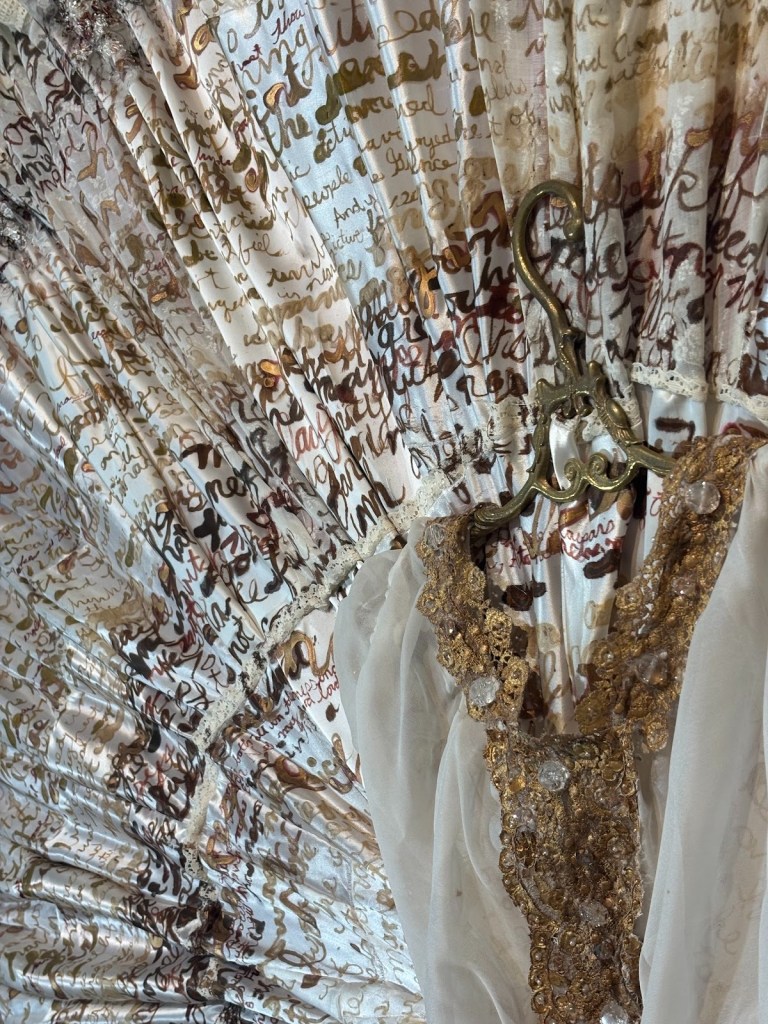
Detail
Adrienne McNeill Herndon was an actress, professor, architect, and the wife of Alonzo Herndon, Atlanta’s first black millionaire. At an early age, she showed a considerable amount of promise as an actor. Born with fair skin, she hid her mixed heritage on the stage. Her desire was to star in all of Shakespear’s plays. She commenced this undertaking, but soon ran into prejudice, and her career was cut short. She returned to her home in Atlanta and received an academic position at Atlanta University, as a professor of Drama and Elocution. She brought Shakespeare and a rigorous standard of elocution to Atlanta University, performing Shakespearean plays each year, at commencement.
She designed her home, which still stands today as a museum in Atlanta: the Herndon house. It is unique in many ways, with a terraced roof which was meant to be used as a stage for performances. Her home is rich with symbolism and reminders of her heritage, as she and her husband forged a future together. In the Herndon home, mahogany wood adorns the walls, with beautiful carvings that have been worked by skilled black artisans. It is a home that is engulfed by culture and the highest society of its day. In Adrienne’s music room, soft pink walls are framed with white and gold embellishments.
The home, in all its luxury, retains reminders of the past. For example, every room has a fireplace, some with cooking pots hanging in them. These do not provide heat for the home or for food preparation. They are reminders of humble beginnings and of slavery. A mural stretches the border of the ceiling in one room, illustrating a symbolic journey of Alonzo’s life: born into slavery, and his rising into an abundant, successful life. Adrienne’s design of this home is almost a set designed for living theater. Her thoughts of how one moves through the home, the symbols, the beauty, and the ability to contemplate and express the past are all read, as one moves through her home.
Adrienne’s dress is made from the fabric of multiple dresses, which were found at vintage stores, and include a wedding dress, woman’s vintage night gown, laces, and beads. The text on the dress includes Adrienne’s own words from articles she wrote or quotes from newspapers and her letters. Much of her writings talk about her work in elocution, the study of expressive speech, pronunciation, and articulation. Texts from plays in which she starred, such as Shakespeare’s Antony and Cleopatra, and a play named ‘Everyman’, are also included in the dress. The words flow on the dress like calligraphy, reflecting the concerns of style, beauty, and expression, which were so important to her career. The hanger is vintage, made of brass. It was found on a luxury cruise ship from the 1900s. Her dress is not dyed. It is left white so that words can be the dominant feature, as they were so important in her life.
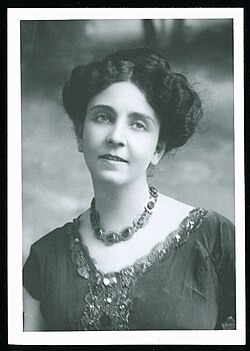
 Sara Lynne Lindsay